
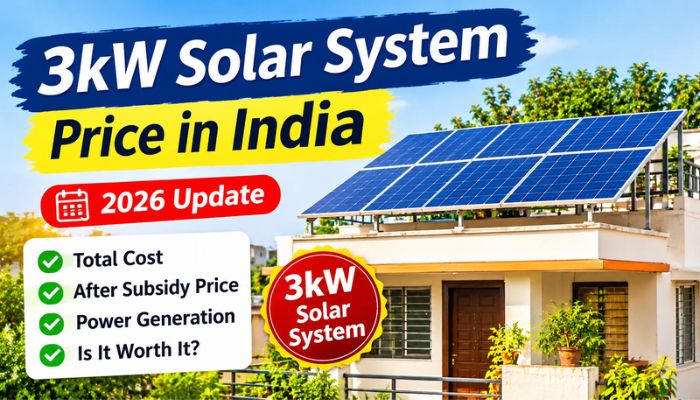
The 3kW solar system price in India in 2026 usually falls between ₹1.5 lakh and ₹2.6 lakh before subsidy, depending on the city, panel type, and what the quote covers. An eligible household can receive ₹78,000 from PM Surya Ghar, which brings the effective cost to roughly ₹72,000 to ₹1.82 lakh before any charges left out of the quote. What you ultimately pay depends on the equipment, the installer’s quote, subsidy eligibility, and those exclusions.
This guide breaks down where the money goes, shows how to check a quotation in a few minutes, and flags the rules that can quietly cost you the subsidy. One date matters right now: the transitional cell-sourcing exemption for net-metered rooftops outside the scheme ends on 31 December 2026, covered in the DCR section below.
Table of Contents
3kW Solar System Price in India 2026: Quick Cost Overview
| Item | Indicative figure |
| System capacity | 3kW, usually 5 or 6 modules |
| Installed price before subsidy | ₹1.5 lakh to ₹2.6 lakh (about ₹50 to ₹87 per watt) |
| Central subsidy | ₹78,000, subject to eligibility |
| Effective cost after subsidy | ₹72,000 to ₹1.82 lakh, before exclusions |
| System type | Grid-tied (on-grid) with net meter |
| Monthly generation | About 300 to 400 units |
| Rooftop area | About 28 to 30 sq m, shadow-free |
| Equipment life | Panels: 25 to 30 year warranties. Inverter: shorter |
The lower end comes from a Business Today estimate of ₹1.5 lakh to ₹2 lakh. The upper end reflects SolarSquare’s published starting prices of ₹2.15 lakh to ₹2.6 lakh across cities on 7 October 2026. Both are installer-side figures, not an official national average. Generation follows PIB’s average of over 300 units a month. Roof area is a rule of thumb.
What Is the Actual Cost of a 3kW Solar System After Subsidy?
The 3kW solar system price in India with subsidy starts with the scheme formula. PM Surya Ghar pays ₹30,000 per kW for the first 2kW and ₹18,000 for the third kW, capped at ₹78,000. Confirm current rates on the PM Surya Ghar portal. In simple terms: gross installation cost, minus eligible subsidy, plus excluded expenses, equals your effective cost.
| Scenario | Gross quote | Central subsidy | State top-up | Excluded expenses | Effective cost |
| A | ₹1,80,000 | ₹78,000 | ₹0 | ₹0 | ₹1,02,000 |
| B | ₹2,15,000 | ₹78,000 | ₹0 | ₹15,000 | ₹1,52,000 |
| C (Uttar Pradesh) | ₹2,17,000 | ₹78,000 | ₹30,000 | ₹10,000 | ₹1,19,000 |
Worked examples, not quotations. Subsidy amounts may change, so check the portal on the date you apply. You generally pay the vendor first. The subsidy follows commissioning, about 15 days after a valid request, according to PIB. That means your peak cash outlay equals the full gross quote, not the post-subsidy figure. In Scenario A, you need ₹1,80,000 up front and wait for ₹78,000 to come back. State top-ups apply only where confirmed. Uttar Pradesh’s UPNEDA scheme pays ₹15,000 per kW up to ₹30,000, as Mercom reported, and applicants use the national portal. Gujarat’s October 2026 top-up covers systems only up to 2.18kWp, so it does not lift a full 3kW plant.
How a bank loan interacts with the subsidy?
With a bank loan, the subsidy can be credited to the loan account, as Central Bank of India shows. That changes the interest arithmetic, so read the two cases below carefully. They use the same loan and rate: ₹2,00,000 borrowed at 7% for 10 years.
| Case | Monthly EMI | Total interest over the loan |
| Subsidy kept separately; loan runs full 10 years on ₹2,00,000 | About ₹2,322 | About ₹78,660 |
| ₹78,000 subsidy credited to the loan, balance of ₹1,22,000 re-amortised over 10 years | About ₹1,417 | About ₹47,983 |
| ₹78,000 credited, EMI kept at ₹2,322, tenure shortens | About ₹2,322 for about 63 months | About ₹24,106 |
Whether a bank lowers the EMI or shortens the tenure after a subsidy credit differs by lender, so ask which method applies. Loan interest is a financing cost, not a deduction from the 3kW solar system price in India.
Complete 3kW Solar Installation Cost Breakdown
Shares below come from two installer-published breakdowns, Bridgeway Power and Myr Solar, so treat them as indicative. No public source gives reliable itemised prices. The percentages are shares of the pre-GST base cost, and GST is added on top unless your quote says it is included.
| Component group | What it covers | In a turnkey quote? | Share of pre-GST base cost |
| Solar panels | Generate DC power | Yes | 45 to 53% |
| Grid-tied inverter | Converts DC to AC | Yes | 15 to 17% |
| Mounting structure | Holds panels | Yes, standard height | 10 to 12% |
| Cables and protection | DC and AC cables, DCDB, ACDB, earthing, lightning protection | Yes, up to a fixed cable length and a basic set | 12 to 15% |
| Labour, transport, commissioning | Mounting, wiring, delivery, testing | Usually | 10 to 15% |
| Net-metering expenses | Application and meter | Varies, check | Outside the shares above; ₹0 in many states, ₹2,000 to ₹12,000 elsewhere |
| GST (added on top) | 5% on goods, 18% on services | Confirm if included | About 8.9% on top; about 8.2% of a GST-inclusive quote |
The component ranges overlap because they come from different installers, so the midpoints land close to 100%. Do not add the GST row to them.
A five-minute sanity check on any quote
Divide the total by the array size in watts. At ₹1.5 lakh to ₹2.6 lakh for a 3kW plant, the range works out to roughly ₹50 to ₹87 per watt-peak. A figure far below that usually means something is missing, such as DCR modules, protection gear or net-metering help. A figure far above it needs a reason, such as an elevated structure or premium inverter. Then check that the panel line is about half of the base price, as the table suggests.
Hidden Charges in a 3kW Solar Installation That Homeowners Should Check?
Not every installer charges these separately. Check your quotation line by line:
- Roof structure and mounting. Standard structures assume a flat RCC roof at normal height. Elevated structures, sheet roofs and waterproofing can add cost.
- Extra wiring and electrical work. Quotes commonly assume 15 to 20 metres of cable. Multi-storey houses or distant meters mean longer runs, conduit and extra breakers. Ask for the rate beyond the included length.
- Net metering and DISCOM charges. Thirty-two states and UTs have removed application and net-metering charges, and feasibility checks are waived up to 10kW. Where fees remain, installer guides report ₹2,000 to ₹12,000. Check that your sanctioned load covers the plant, because some DISCOMs compare it with the DC array size in kWp, and a load increase carries its own fee.
- Transportation and access. Remote locations, narrow lanes and high-rise roofs raise handling effort and may need a crane. Ask if delivery is priced in.
- GST and exclusions. GST on solar power generating systems fell from 12% to 5% on 22 September 2025, while the services portion stays at 18%. A 70:30 split gives about 8.9% overall (0.70 x 5% + 0.30 x 18%), so a ₹1.8 lakh quote shown as “plus GST” adds about ₹16,000.
- Maintenance and replacement. Panels need little beyond periodic inspection. The inverter is the likeliest replacement, at 15 to 17% of a ₹2 lakh quote, or ₹30,000 to ₹34,000. Check its warranty. This guide assumes ₹1,500 a year for upkeep.
- Loan processing. PIB cites collateral-free loans at around 7% for systems up to 3kW, though bank rates differ. A 0.25% processing fee, as some banks list, adds ₹500 on ₹2 lakh.
Before Paying an Advance, Ask Your Solar Installer These 10 Questions?
- What is the final price including GST, and what is excluded?
- Which panel brand, model and wattage, and is it DCR compliant?
- Which inverter model, and what warranty and service terms?
- What structure is included, and who pays for extra structural work?
- How many metres of cable are included, and what is the rate beyond?
- Who handles DISCOM, net-metering and portal paperwork, and who pays meter fees?
- Will you assist with the subsidy claim?
- What are the payment milestones?
- What warranty covers workmanship?
- Who attends a fault, and within how many days?
DCR vs Non-DCR Solar Panels: How They Affect Your 3kW System Price?
DCR rules shape the 3kW solar system price in India more than most buyers expect. DCR means Domestic Content Requirement. PIB states that PM Surya Ghar mandates modules and cells made in India. If you want the ₹78,000 subsidy, a panel assembled in India from imported cells does not qualify.
From 1 June 2026, ALMM List-II extends the approved-manufacturer rule to solar cells, and MNRE says this does not dilute DCR for government schemes. Non-DCR panels typically cost less, so ask for both quotes, but a subsidy claim needs DCR modules.
The transitional relief is narrower than it sounds:
- It waives only the List-II requirement for cells. ALMM List-I, the approved list of module models and manufacturers, still applies to grid-connected net-metered installations.
- Residential consumers who give up the subsidy get time until 31 March 2027, but only if they register under the “Give It Up” option on the PM Surya Ghar national portal.
- Net-metered rooftops outside the scheme, applied for directly through the DISCOM, must be commissioned by 31 December 2026 to use the exemption.
To verify, ask for the module datasheet and DCR certificate, and check the model on both ALMM List-I and List-II on the MNRE website.
3kW Solar System Price by Panel Brand
No public source gives verified brand-wise installed prices, so none are listed here. Panels are roughly half of a turnkey price, so a panel price is not a system quote. Loom Solar’s website lists five 550W modules for ₹65,000, but that is a 2.75kWp kit, panels alone, and its DCR status is not stated. A full 3kW array needs six 550W modules (3.3kWp), which at the same rate is about ₹78,000 for panels only.
Size matters for the subsidy too. Under the formula, 2.75kWp works out to ₹60,000 plus three-quarters of ₹18,000, or about ₹73,500, not ₹78,000. Confirm how the portal treats capacity just below 3kW before you finalise the array.
| Brand | Published warranty or service detail | Check |
| Tata Power Solar | 25-year module warranty; also installs | Model and installer partner |
| Waaree | TOPCon bifacial: 12-year product, 30-year performance (2023 report) | Current datasheet and DCR status |
| Adani Solar | ELAN TOPCon: 12-year product, 30-year performance | Dealer service speed |
| Vikram Solar | One comparison site lists up to 15 and 30 years on select models | Datasheet confirmation |
Judge by ALMM and DCR status, efficiency, warranties and local service, not by rank.
State-Wise 3kW Solar System Price in India?
| State | Indicative price | Central subsidy | State incentive | DISCOMs and nodal agency |
| Uttar Pradesh | About ₹2.17 lakh, Lucknow | ₹78,000 | ₹30,000 via UPNEDA | Regional DISCOMs (MVVNL, PVVNL, PuVVNL, DVVNL, KESCO, NPCL); nodal agency UPNEDA |
| Maharashtra | About ₹2.27 lakh, Pune | ₹78,000 | None verified | MSEDCL (plus private utilities in Mumbai); nodal agency MEDA |
| Gujarat | About ₹2.15 lakh, Ahmedabad | ₹78,000 | Top-up only up to 2.18kWp | UGVCL, MGVCL, DGVCL, PGVCL, Torrent Power; nodal agency GEDA |
| Rajasthan | About ₹2.15 lakh, Jaipur | ₹78,000 | Category-based support reported | JVVNL, AVVNL, JdVVNL; nodal agency RRECL |
| West Bengal | Not verified | ₹78,000 | None verified | WBSEDCL, CESC; nodal agency WBREDA |
| Karnataka | About ₹2.47 to ₹2.6 lakh, Bengaluru | ₹78,000 | None verified | BESCOM, MESCOM, HESCOM, GESCOM, CESC Mysuru; nodal agency KREDL |
| Tamil Nadu | About ₹2.23 to ₹2.35 lakh, Chennai | ₹78,000 | None verified | TNPDCL; nodal agency TEDA |
| Kerala | Not verified | ₹78,000 | Own scheme, check combination | KSEB; nodal agency ANERT |
| Madhya Pradesh | About ₹2.25 lakh, Bhopal | ₹78,000 | None verified | MP regional DISCOMs; nodal agency MPUVNL |
| Chhattisgarh | Not verified | ₹78,000 | One summary lists a top-up, confirm | CSPDCL; nodal agency CREDA |
Pick the DISCOM that actually sends your bill when you register on the portal, since a parent company or nodal agency is not the same thing.
City prices are SolarSquare’s starting prices of 7 October 2026 for one variant. Subsidy rules and net-metering procedures differ by state, so “not verified” rows need local quotations. The 3kW solar system price in UP drops the most because of the state top-up, while the 3kW solar system price in Maharashtra reflects central support only.
3kW On-Grid, Hybrid and Off-Grid Solar System Price
| Feature | On-grid | Hybrid | Off-grid |
| Approximate cost | ₹1.5 lakh to ₹2.6 lakh | About ₹2.5 lakh to ₹4 lakh | About ₹2.4 lakh to ₹4.2 lakh |
| Battery | No | Yes | Yes, usually larger |
| Grid dependency | Full | Grid plus battery | None |
| Backup in power cuts | None | Wired essential loads | Yes |
| Maintenance | Lowest | Battery monitoring | Highest |
| Subsidy | Eligible with DCR modules | Solar part may qualify if grid-connected with net metering; confirm on portal; battery gets none | Not under PM Surya Ghar |
| Suits | Stable grid, daytime use | Frequent outages | No grid access |
Batteries push the 3kW solar system price in India well above the on-grid figure. A grid-tied inverter shuts down during an outage as an anti-islanding safety feature, so it gives no automatic backup. At ₹12,000 to ₹18,000 per kWh, a 5kWh lithium battery adds roughly ₹60,000 to ₹90,000 and lasts about 8 to 12 years. The battery and the hybrid inverter premium carry no subsidy. Off-grid systems can cost more than hybrid ones at the top end because they need enough battery to run without any grid fallback.
How Much Electricity Does a 3kW Solar System Generate in India?
Monthly generation depends on location, sun hours, losses, orientation, tilt, shading, season and degradation. Daily output equals 3kW times peak sun hours times performance ratio.
| Condition | Peak sun hours | Performance ratio | Daily units | Monthly units | Annual units |
| Clear site, no shade | 5.5 | 0.80 | 13.2 | 396 | 4,818 |
| Typical rooftop | 4.8 | 0.77 | 11.1 | 333 | 4,047 |
| Cloudier or partly shaded | 4.2 | 0.72 | 9.1 | 272 | 3,311 |
Monthly and annual figures are calculated from exact daily values (for example 11.088 units a day for the typical rooftop) and then rounded, so they may differ slightly from the rounded daily column multiplied out.
Monsoon months can fall to about 236 units a month, assuming 3.5 peak sun hours and a performance ratio of 0.75 (3 x 3.5 x 0.75 x 30). Output also declines slowly; Adani’s warranty allows up to 1% loss in year one and about 0.4% a year after. These are estimates, not guarantees.
Instantaneous power matters as well. With the same performance ratios, the AC output of a 3kW array peaks at roughly 2.1 to 2.4kW around solar noon in clear weather and is lower in the morning, late afternoon and under cloud.
How Much Money Can You Save With a 3kW Solar System?
Assumptions: ₹7 per unit, ₹200 a month of fixed charges that solar does not remove, and 330 units of monthly generation. Surplus units are assumed to earn no export credit, because rates vary by state.
| Monthly bill | Units used (rounded) | Solar units offsetting the bill | Surplus solar units, no credit assumed | Annual saving | Bill after solar |
| ₹1,000 | 114 | 114 | 216 | ₹9,600 | ₹200 |
| ₹2,000 | 257 | 257 | 73 | ₹21,600 | ₹200 |
| ₹3,000 | 400 | 330 | 0 | ₹27,720 | ₹690 |
Units used are (bill minus ₹200) divided by ₹7, rounded for display. Annual saving uses the exact figure: (₹1,000 minus ₹200) x 12 = ₹9,600 and (₹2,000 minus ₹200) x 12 = ₹21,600. At ₹3,000, 70 units are still bought from the grid: 70 x ₹7 + ₹200 = ₹690.
The 3kW solar system price in India suits bills above roughly ₹2,000. At ₹1,000, generation far exceeds consumption. Tariff slabs, usage timing, export rates and fixed charges all change these results.
3kW Solar System Payback Period in India
Simple payback equals effective cost divided by net annual savings after ₹1,500 upkeep. The two cost columns are Scenario A (₹1,02,000) and Scenario B (₹1,52,000) from the subsidy table above.
| Monthly bill | Net annual saving | Payback at ₹1,02,000 | Payback at ₹1,52,000 |
| ₹1,000 | ₹8,100 | 12.6 years | 18.8 years |
| ₹2,000 | ₹20,100 | 5.1 years | 7.6 years |
| ₹3,000 | ₹26,220 | 3.9 years | 5.8 years |
Simple payback ignores tariff changes, inverter replacement, degradation, loan interest and the time value of money. These are illustrations.
How to Compare Two 3kW Solar Installer Quotations?
The values below are placeholders that show the format, not real quotations. The point is to put every quote on the same basis: tax included, array size stated, subsidy status stated.
| Item | Installer A | Installer B |
| Total price | ₹1,95,000 including GST | ₹1,70,000 plus GST (₹1,85,130) |
| Panel maker and model | Named DCR TOPCon model | Brand not named |
| Module wattage and quantity | 5 x 610W = 3.05kWp | 6 x 540W = 3.24kWp |
| Price per watt-peak, GST included | About ₹63.93 | About ₹57.14 |
| Inverter | Named 3kW model, 8-year warranty | 3kW, brand not named |
| Mounting structure | Raised GI, design stated | Standard height, material not stated |
| Protection equipment | DCDB, ACDB, surge protection, two earth pits | DCDB, ACDB, one earth pit |
| Warranty coverage | Datasheet terms, 5-year workmanship | Not stated |
| Installation and commissioning | Included | Included |
| Net-metering assistance | Included, with portal filing | Left to customer |
| Additional charges | Cable beyond 20m at a stated rate | Not stated |
| Payment terms | 20% advance, 70% delivery, 10% commissioning | 80% advance |
| After-sales service | Written response time | Phone support |
Installer B looks ₹25,000 cheaper, but ₹1,70,000 plus 8.9% GST is ₹1,85,130, which cuts the gap to ₹9,870. The bigger issue is subsidy status. Installer B does not name its modules, and if they are not DCR compliant, the ₹78,000 subsidy is lost.
| If Installer B’s modules are… | Installer A effective cost | Installer B effective cost |
| DCR compliant, subsidy received | ₹1,17,000 | ₹1,07,130 (₹9,870 lower) |
| Not DCR compliant, no subsidy | ₹1,17,000 | ₹1,85,130 (₹68,130 higher) |
Installer B also quotes a 3.24kWp array against a 3kW inverter. Some DISCOMs check sanctioned load against kWp, so confirm that your approved load allows it, and whether a load-enhancement fee applies. The cheapest quotation is not automatically the best.
Collect these from every installer in writing:
- Final price with GST
- Module model, wattage, quantity and DCR certificate
- Inverter model and warranty
- Structure and cable inclusions
- Protection and earthing specification (DCDB, ACDB, surge protection, number of earth pits)
- Net-metering scope
- Payment milestones
- Workmanship warranty
- Fault-attendance time in writing
Is a 3kW Solar System Worth Installing in 2026?
At the current 3kW solar system price in India, it is worth installing when most of these hold: monthly use near 250 units or a bill above ₹2,000, about 28 to 30 sq m of shadow-free roof, a DCR-compliant quote confirming ₹78,000 eligibility, a local tariff near ₹7 a unit, and ownership for at least the payback period.
PIB’s guidance pairs 0 to 150 units with 1 to 2kW and 150 to 300 units with 2 to 3kW, so 2kW suits lower bills. A 5kW system suits use above roughly 450 units, but the subsidy stays at ₹78,000 and the sanctioned load must support it.
Get an Estimate for Your 3kW Solar Installation
If you are comparing quotations, contact MyGreenStarEnergy.com to enquire about installation costs and options. Request a 3kW Solar Installation Cost Estimate and share your state or city, approximate monthly electricity bill and rooftop details such as area and shading. This supports an initial assessment for your location. We cannot promise instant quotations, guaranteed subsidies, or installer availability. For application steps, read our PM Surya Ghar Yojana guide.
Frequently Asked Questions
What is the price of a 3kW solar system in India in 2026?
₹1.5 lakh to ₹2.6 lakh before subsidy, depending on city, equipment and inclusions.
How much does a 3kW solar system cost after subsidy?
About ₹72,000 to ₹1.82 lakh, before excluded charges and any state top-up.
Is the ₹78,000 subsidy available for every 3kW solar installation?
No. It needs an eligible residential connection, DCR modules and portal registration.
How many units does a 3kW solar system generate per day?
Roughly 9 to 13 units, and about 8 in the monsoon at 3.5 peak sun hours.
Can a 3kW solar system run a 1.5-ton AC?
In daylight it can supply much of the load, since most 1.5-ton inverter ACs draw under 3kW. But a 3kW array delivers roughly 2.1 to 2.4kW of AC at its peak, and less in the morning, evening and monsoon. On an on-grid system, any shortfall is drawn from the grid at that moment, not only at night.
How much rooftop space is needed for a 3kW solar system?
About 28 to 30 sq m of shadow-free area.
Does a 3kW on-grid solar system work during power cuts?
No. It shuts down in an outage for grid safety. Backup needs a hybrid system.
What is the difference between 3kW on-grid and hybrid solar?
On-grid has no battery and exports through net metering. Hybrid adds a battery and backup circuit.
Is net metering included in the installation price?
Not always. Meter or load-increase fees may sit outside the quote.
How long does it take to recover the cost of a 3kW system?
About 4 to 19 years in the tables above, mostly depending on your bill. Nothing is guaranteed.
Which solar panel brand is best for a 3kW system?
No single best brand. Compare ALMM and DCR status, warranty and service network.
Are batteries included in a standard 3kW installation?
No. Batteries belong to hybrid or off-grid systems and are not subsidised.
What documents are required to claim the subsidy?
Registration usually needs an electricity bill, Aadhaar and bank details with a cancelled cheque. At the claim stage you also need the vendor’s tax invoice, DCR module certificate and serial numbers, and the DISCOM’s commissioning or net-metering approval. Our PM Surya Ghar guide has the full list.
Can I install a 3kW system if my monthly electricity bill is ₹1,000?
Yes, but about 114 units a month needs only 1kW to 1.5kW, and 3kW would take over a decade to pay back.
Does a 3kW system require regular maintenance?
Little: periodic inspection and eventual inverter replacement.
Final Verdict
A low 3kW solar system price in India means little unless the quotation is complete. The right system is not the cheapest. It has transparent pricing, DCR modules, a clearly warranted inverter, a suitable roof and a stated subsidy route. Confirm that the quote covers GST, structure, cable and approvals, and weigh payback against your own bill. To review a quotation, request an installation cost estimate, mail us: info@mygreenstarenergy.com
Sources
Prices and policy items are indicative and were drawn from the sources below. Dates are those shown in each source or its address. Re-check the official portals before you pay an advance.
- PM Surya Ghar national portal
- Ministry of New and Renewable Energy
- PIB: PM Surya Ghar progress note, March 2025
- Energetica India: MNRE detailed clarification on ALMM List-II applicability, 2026
- Energetica India: Gujarat additional state subsidy for rooftop solar up to 2.18kWp, October 2026
- Mercom India: PM Surya Ghar progress and net-metering charges
- Mercom India: UP announces subsidy for residential rooftop solar (UPNEDA)
- Mercom India: Rajasthan on GST rate cut for clean energy equipment
- PV Tech: India cuts GST on renewable energy components, 22 September 2025
- SolarSquare: 3kW solar plant price, 7 October 2026
- Business Today: PM Surya Ghar cost example, 28 July 2026
- Central Bank of India: rooftop solar loan scheme
- Bridgeway Power: PM Surya Ghar 3kW price and subsidy
- Bridgeway Power: hidden costs in rooftop solar quotations
- Myr Solar: 3kW solar system in India
- Myr Solar: PM Surya Ghar bank loan list
- Loom Solar: 3kW solar panel listing
- Tata Power Solar
- SolarQuarter: Waaree N-type TOPCon modules, 5 January 2023
- TaiyangNews: Adani Solar 640W TOPCon module
- Infobits: best solar panel brands (Vikram Solar warranty listing)
- Qbits Energy: on-grid vs hybrid inverters ROI, 8 April 2026
- QuickEstimate: hybrid solar glossary
MyGreenStarEnergy.com is an independent informational website and is not affiliated with the Ministry of New and Renewable Energy or the Government of India. Prices, subsidy amounts and rules may change.