
Nov 11, 2026
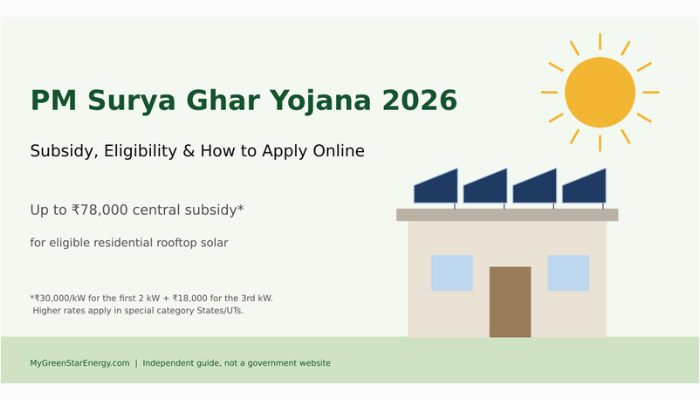
A rooftop solar system can take a large bite out of a household’s bijli bill for 25 years, and the PM Surya Ghar Yojana 2026 rules make the upfront cost far easier to manage. PM Surya Ghar: Muft Bijli Yojana is the Government of India’s rooftop solar scheme for residential electricity consumers. It pays Central Financial Assistance (CFA) directly to your bank account after a grid-connected system is installed and inspected.
The standard maximum central subsidy is ₹78,000 for eligible homes installing 3kW or more, as per current MNRE rooftop solar guidelines. One clarification up front: “up to 300 free units” is the scheme’s objective, not a DISCOM promise. Your actual savings depend on how much your system generates and how much you consume. Applications are made only through the official PM Surya Ghar portal.
Table of Contents
PM Surya Ghar Yojana 2026 — Quick Overview
| Particular | Details |
|---|---|
| Official scheme name | PM Surya Ghar: Muft Bijli Yojana (PMSG: MBY) |
| Launch date | Launched 13 February 2024; approved by the Union Cabinet on 29 February 2024 |
| Implementing ministry | Ministry of New and Renewable Energy (MNRE) |
| Main objective | Rooftop solar for 1 crore households, with an aim of up to 300 units of free electricity a month for participating homes |
| Total outlay | ₹75,021 crore |
| Eligible beneficiaries | Residential electricity consumers with a valid DISCOM connection |
| Standard maximum central subsidy | ₹78,000 (₹85,800 in special category States/UTs) |
| System type | Grid-connected rooftop solar with domestically manufactured (DCR) modules |
| Application mode | Online, through the national portal |
| Official website | pmsuryaghar.gov.in |
| Latest verified status | Active. Over 65 lakh rooftop installations announced on 4 November 2026 |
| Implementation period | Till 31 March 2027, as per MNRE operational guidelines |
Official PM Surya Ghar Yojana Portal
Registration, the rooftop solar application, vendor selection, application tracking and the subsidy claim are all handled on the Government of India’s national portal. You do not need to pay any agent or private website to apply.
Visit the official PM Surya Ghar portal to apply or log in
How Much Subsidy Is Available Under PM Surya Ghar Yojana in 2026?
The subsidy is a fixed amount per kilowatt, not a percentage of your quotation. MNRE pays ₹30,000 per kW for the first 2kW and ₹18,000 for the third kW. Nothing extra is paid beyond 3kW. Households in special category States and UTs get ₹33,000 per kW for the first 2kW and ₹19,800 for the third. These rates have not changed since the scheme began, according to the CFA guidelines published by MNRE.
| Rooftop Solar Capacity | Standard Central Subsidy | Special Category States/UTs |
|---|---|---|
| 1kW | ₹30,000 | ₹33,000 |
| 2kW | ₹60,000 | ₹66,000 |
| 3kW | ₹78,000 | ₹85,800 |
| 5kW | ₹78,000 | ₹85,800 |
| 10kW | ₹78,000 | ₹85,800 |
The central subsidy rises to 3kW and then stays flat.
Subsidy for a 1kW Solar System
A 1kW system suits a small family whose monthly use is roughly 100–150 units, or a home with a limited shadow-free terrace. The subsidy is ₹30,000. Because fixed installation costs (structure, earthing, wiring, net meter) don’t shrink much with size, the cost per kW is usually highest at 1kW.
Subsidy for a 2kW Solar System
A 2kW system gets ₹60,000 and is a sensible size for homes using about 150–300 units a month. That covers many 2BHK households running fans, a fridge, a washing machine and occasional AC use.
Subsidy for a 3kW Solar System
3kW is where you get the full ₹78,000. It typically suits households using 300 units or more a month. Before choosing it, check two things: whether your sanctioned load allows a 3kW connection (some DISCOMs require a load enhancement), and whether your terrace has about 25–30 square metres of usable, shadow-free space. Fractional sizes are also calculated per kW, so a 2.5kW system gets ₹69,000.
Is There Additional Subsidy for 5kW or 10kW?
No. The central subsidy is capped at ₹78,000 (₹85,800 in special category regions). A 5kW or 10kW system can still be installed through the portal, but you pay the full cost of every kilowatt above 3kW.
Do Subsidy Amounts Differ by State?
The central amount differs only between general and special category regions. Special category regions include the North-Eastern states, Uttarakhand, Himachal Pradesh, Jammu & Kashmir, Ladakh, Andaman & Nicobar Islands and Lakshadweep.
Some states add their own top-up on top of the central CFA. Uttar Pradesh, for example, offers ₹15,000 per kW up to ₹30,000. Tamil Nadu announced an additional ₹5,000, ₹10,000 or ₹22,000 (for 1kW, 2kW and 3kW+) for consumers registering on the portal from 5 August 2026.
Many states offer no top-up at all, so never assume one. Ask your DISCOM or state nodal agency for the current government order before counting it in your budget.
Who Is Eligible for PM Surya Ghar Yojana?
The MNRE operational guidelines for residential CFA set out these core conditions:
- Residential consumer: You must hold a valid consumer account number with your DISCOM, and the connection must be in a residential/domestic category.
- Grid-connected system: The system must be connected to the grid. Off-grid systems are not eligible for CFA.
- Installation location: A roof, terrace, balcony or elevated structure qualifies. Elevated structures need at least 8 feet of clearance at the lowest point.
- Rights to the roof: You need the right to install on that roof. Ownership proof or the owner’s consent is usually checked by the DISCOM or vendor.
- One-time subsidy: CFA is given only once. If you received CFA earlier and are expanding, you can only claim the balance up to 3kW in total. Relocated systems are not eligible.
- Approved equipment: Modules must be DCR (made in India with Indian cells). Using any non-DCR module makes the installation ineligible for CFA.
- Registered vendor: The system must be installed by a vendor registered on the portal for your DISCOM area.
- Aadhaar: Since March 2026, Aadhaar authentication (or proof of possession of an Aadhaar number) is mandatory to receive the subsidy.
Can Tenants Apply for PM Surya Ghar Yojana?
The central guidelines do not specifically mention tenants. In practice, the application is tied to the electricity consumer number, so the person in whose name the connection stands applies.
If you rent and the connection is in your name, you will still need the property owner’s written permission to use the roof, and the DISCOM or vendor may ask for it. If the connection is in the owner’s name, the owner should apply. Confirm the documents your DISCOM accepts before signing a vendor agreement.
Can Apartment Owners Apply?
A flat owner rarely has an exclusive roof, so individual applications from apartments are uncommon. Housing societies and RWAs can claim CFA of ₹18,000 per kW (₹19,800 in special category regions) for a system powering common facilities such as lifts, pumps, corridor lights and EV charging.
This is allowed up to 500kW, counted at 3kW per house. Some states also allow virtual or group net metering, so check with your DISCOM and society committee.
Are Commercial Properties Eligible?
No. Shops, offices, factories, institutions and government buildings get no CFA under the residential component. Commercial rooftop solar is installed at full cost, sometimes with separate state incentives or tax benefits. A mixed-use building is assessed by its connection category, not by how the owner describes it.
Is There an Income Limit?
The MNRE guidelines for residential CFA do not set any income ceiling. Websites claiming an income cut-off such as ₹1.5 lakh are mixing this up with other state schemes. Separate utility-led models do target PMAY, BPL and SC/ST households in some states, but that is a different delivery route.
Documents Required for PM Surya Ghar Yojana
| Document / Detail | Why it is needed | Status |
|---|---|---|
| Recent electricity bill | Confirms DISCOM, connection category and sanctioned load | Required |
| Electricity consumer number | Your primary ID on the portal (not the meter number) | Required |
| Mobile number | OTP login and status alerts; ideally linked to Aadhaar | Required |
| Aadhaar authentication | Mandatory for receiving CFA since March 2026 | Required |
| Bank account proof | Cancelled cheque, passbook or e-statement for DBT | Required |
| Loan account details | Only if the system is financed | If applicable |
| Roof ownership or owner’s consent | Property tax receipt, sale deed or NOC | Often asked by DISCOM/vendor |
| Installation documents | Geo-tagged photos, module and inverter specs, serial numbers, warranty cards, layout and single-line diagram, completion report | Uploaded after installation (vendor usually helps) |
| Net metering agreement | Signed with the DISCOM | Required at metering stage |
| PAN, photograph or feasibility papers | Asked by some banks or state rules | Depends on DISCOM/bank |
The single most common problem is a mismatch between the name on the electricity bill, Aadhaar and the bank account. Fix that before you apply.
How to Apply for PM Surya Ghar Yojana Online in 2026?
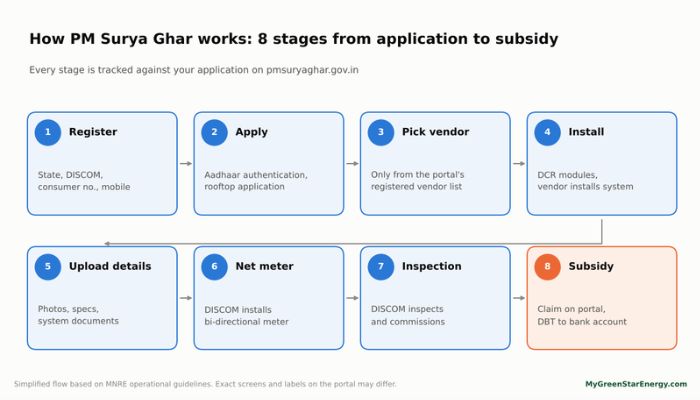
The steps below follow the process in MNRE’s operational guidelines. Button labels on the portal change from time to time, so follow the on-screen prompts where they differ.
Step 1 — Visit the Official PM Surya Ghar Portal
Open pmsuryaghar.gov.in directly in your browser and choose the option to apply for rooftop solar. Avoid look-alike websites or links shared on WhatsApp.
Step 2 — Register Using Your Electricity Connection Details
Select your state and DISCOM (for example, MSEDCL in Maharashtra, UPPCL’s distribution companies in Uttar Pradesh, BESCOM in Bengaluru, TNPDCL in Tamil Nadu or CSPDCL in Chhattisgarh). Enter your consumer number exactly as printed on the bill, then verify your mobile number with an OTP.
Step 3 — Complete the Rooftop Solar Application
Log in, complete Aadhaar authentication and fill in the application with your details and proposed capacity. The portal generates an application ID; note it down. For systems up to 10kW, technical feasibility is now deemed approved in most cases, so a separate DISCOM feasibility visit is generally not needed.
Step 4 — Select a Registered Solar Vendor
Pick an installer from the registered vendor list shown on the portal for your DISCOM area. More than 37,000 vendors are registered nationwide. Get two or three written quotations that list module make and wattage, inverter brand, structure height and material, warranty terms and who pays the net-meter charges.
Step 5 — Complete the Solar Installation
The vendor installs the system using DCR modules, carries out safety checks and explains basic operation. You or the vendor then upload installation details, geo-tagged photos and equipment documents on the portal.
Step 6 — DISCOM Inspection and Net Metering
After installation, you sign the net-metering agreement and the DISCOM installs a bi-directional net meter. The DISCOM then physically inspects the system and approves it, which leads to commissioning.
Step 7 — Complete the Subsidy Claim Process
Once the DISCOM approves, your subsidy becomes available on the portal against your installed capacity. You submit the claim with your bank details. If you have a bank loan, the CFA may be credited to the loan account first.
Step 8 — Track Subsidy Approval and Payment
Payment is made by Direct Benefit Transfer. The guidelines target processing within 15 days of DISCOM approval, but actual timing depends on correct bank and Aadhaar details. Track progress by logging into the portal with your registered mobile number.
How to Check PM Surya Ghar Application and Subsidy Status
How to Track Your Application Online
Go to pmsuryaghar.gov.in, choose the consumer or applicant login (also reachable at the consumer login page), and sign in with your registered mobile number and OTP. Your dashboard shows which stage the application has reached.
What Do the Different Application Statuses Mean?
Exact wording differs between DISCOMs, but the stages follow the same order:
- Registration and application submitted
- Vendor selected
- Installation details submitted
- Net meter installed
- Inspection completed and system commissioned
- Subsidy claim submitted
- Subsidy released
If an application is “returned”, the DISCOM has found a problem, and the reason should be visible in the application details.
What If the Subsidy Has Not Been Credited?
Check, in order:
- Whether the claim was actually submitted after DISCOM approval.
- Whether the bank account is active, Aadhaar-seeded and the IFSC is correct.
- Whether the name on your bank account, Aadhaar and electricity bill matches.
- Whether the DISCOM inspection is still pending.
If everything is correct and the status hasn’t moved for several weeks, raise a grievance on the portal or call the national helpline 15555.
What If Your Application Is Rejected?
Read the rejection reason first. Most are correctable, such as a wrong consumer number, non-residential category, unclear photos or a document mismatch. Your vendor can often resubmit corrected documents.
If you disagree with the decision, raise a grievance through the portal, the PM Surya Ghar app or the national call centre (15555). Each grievance gets a tracking ID, and the guidelines target resolution within 30 days. Unresolved complaints can also be escalated to your DISCOM’s consumer grievance forum or CPGRAMS.
PM Surya Ghar Yojana Installation Cost After Subsidy
There is no government-fixed price for homeowners; each vendor quotes its own price. The ranges below are drawn from published 2026 price lists and quotation guides from Indian installers for on-grid systems with DCR modules. Premium brands in metro cities can cost more.
| System | Indicative gross cost (2026) | Central subsidy | Estimated net cost | Assumptions/exclusions |
|---|---|---|---|---|
| 1kW | ₹60,000–₹90,000 | ₹30,000 | ₹30,000–₹60,000 | Standard structure; net-meter charges vary |
| 2kW | ₹1.1–₹1.5 lakh | ₹60,000 | ₹50,000–₹90,000 | Excludes battery and load enhancement |
| 3kW | ₹1.5–₹2.4 lakh | ₹78,000 | ₹72,000–₹1.62 lakh | Upper end reflects premium brands/elevated structures |
| 5kW | ₹2.3–₹3.5 lakh | ₹78,000 | ₹1.52–₹2.72 lakh | Larger roof area and sanctioned load needed |
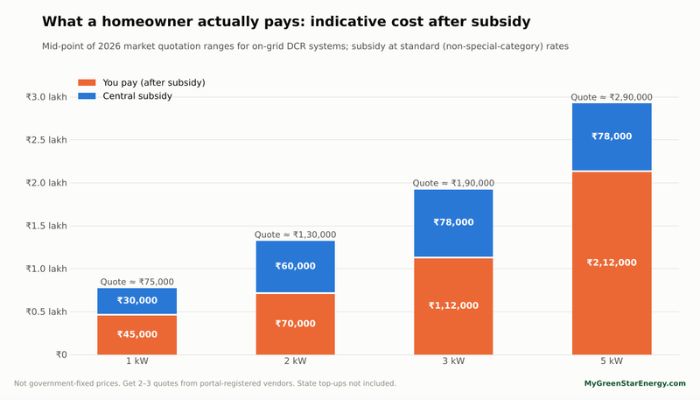
Mid-point estimates for illustration. State top-ups, where available, reduce the net cost further.
Why two quotes for the same 3kW system can differ by ₹50,000 or more:
- Module technology: mono PERC vs TOPCon, wattage and brand.
- Inverter: brand, warranty length and remote monitoring.
- Mounting structure: galvanised steel vs aluminium, and raised structures that keep the terrace usable below.
- Roof condition: waterproofing, parapet height and access for heavy material.
- Location: transport and labour costs, especially in hill states and islands.
- Electrical protection: earthing, lightning arrester, DC/AC distribution boxes and cable quality.
- Net-metering expenses: meter cost, testing and agreement charges set by your DISCOM.
- Warranty and service: whether the quote includes a multi-year maintenance contract.
How Much Electricity Can a Rooftop Solar System Generate in India?
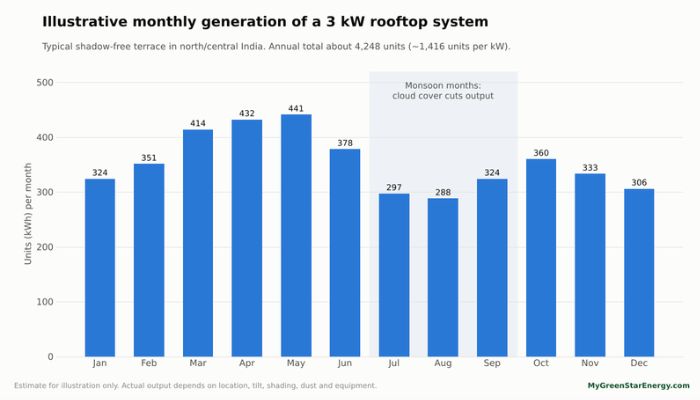
Across most of India, a well-installed, shadow-free system produces about 1,350–1,550 units per kW per year. Rajasthan and Gujarat are usually at the higher end, while the North-East and coastal regions with long monsoons are lower.
| System size | Average units per day | Average units per month | Units per year |
|---|---|---|---|
| 1kW | 3.7–4.3 | 110–130 | 1,350–1,550 |
| 2kW | 7.4–8.5 | 225–260 | 2,700–3,100 |
| 3kW | 11–12.7 | 340–390 | 4,050–4,650 |
Assumptions: south-facing modules at a suitable tilt, no shading, clean panels and typical system losses of 18–22%. These are engineering estimates, not guaranteed output.
How Much Rooftop Space Is Required?
Plan for roughly 8–10 square metres (about 90–110 sq ft) of shadow-free area per kW on a flat terrace. That allows for row spacing, so one row doesn’t shade the next, and walkways for cleaning.
Water tanks, staircase rooms, neighbouring buildings and trees all cast shadows that move with the seasons. A partly shaded panel can drag down the output of the whole string, so a good vendor should show you a shading assessment, not just measure the roof.
Does Solar Work During the Monsoon?
Yes, but at lower output. Thick cloud can cut daily generation by 30–50% on bad days, and July–August are usually the weakest months.
Net metering helps here: surplus units exported in March–May are credited against your monsoon consumption, depending on your state’s settlement period. Judge a system by its annual generation, not by a rainy week.
Can a 3kW Solar System Eliminate Your Electricity Bill?
For some households, nearly. A 3kW system producing 340–390 units a month can cover a home using 300 units a month on an annual basis. MNRE reported that over 21 lakh households were receiving zero electricity bills by November 2026. But several things decide whether your bill actually reaches zero:
- Fixed or demand charges and electricity duty usually still apply.
- Summer AC use can push consumption well above generation.
- Exported units may be valued at a lower rate than imported units.
- Net-metering settlement rules vary by state.
- Credits may lapse at the end of a billing year.
Does Rooftop Solar Work During a Power Cut?
A standard grid-connected system shuts down during a grid outage. This anti-islanding protection is built into on-grid inverters so that solar power doesn’t flow back into lines that linemen are repairing. A typical PM Surya Ghar system will therefore not run your fans during a power cut, even at noon.
If outages are frequent in your area, ask about a hybrid inverter with a battery, which can isolate the home from the grid and keep essential loads running. This costs extra, the battery is not covered by the subsidy, and the configuration must still meet DISCOM requirements.
Can You Get a Bank Loan for PM Surya Ghar Yojana?
Yes. Public sector banks offer a dedicated rooftop solar loan, applied for through the Jan Samarth portal, which is integrated with the national portal.
- Up to 3kW: collateral-free loans up to ₹2 lakh at repo rate plus 0.5%, which was 5.75% a year in mid-2026, with tenure up to 10 years. The equipment is usually hypothecated to the bank.
- Above 3kW to 10kW: loans up to ₹6 lakh at higher rates, for example, 7.90% on SBI’s PM Surya Ghar loan page.
- Margin money: typically 10% for loans up to ₹2 lakh and 20% for larger loans. See Indian Bank’s rooftop solar scheme for an example.
- Charges: some banks advertise nil processing and prepayment charges, but confirm this on your sanction letter.
Rates are linked to the RBI repo rate, so they can change, and approval still depends on the bank’s credit assessment. The subsidy does not reduce the loan at sanction. It is credited after commissioning and may first be adjusted against the loan account.
PM Surya Ghar Yojana Last Date and Latest Updates in 2026
Is there a last date? The scheme’s implementation period runs till 31 March 2027. That is an implementation timeline, not a fixed application deadline. Applications remain open on the portal as of November 2026, but your system must be installed, inspected and claimed while the scheme is active. Since installation and DISCOM inspection take weeks, applying in early 2027 leaves little margin.
Latest verified updates:
- Progress: Union Minister Pralhad Joshi said in November 2026 that installations crossed 65 lakh, with more than one lakh added every six days.
- Subsidy rates: unchanged at ₹30,000/₹18,000 per kW with a ₹78,000 cap.
- Aadhaar: mandatory authentication for CFA from March 2026.
- “Give It Up” option: consumers who voluntarily forgo the subsidy may use non-DCR modules until 31 March 2027. If you want the subsidy, DCR modules remain compulsory.
- State top-ups: Tamil Nadu added a state subsidy for registrations from 5 August 2026. Check your own state.
- Old Phase-II claims: the November 2026 claim-deadline extension applies only to legacy claims under the old rooftop programme, not to new PM Surya Ghar applicants.
Has PM Surya Ghar 2.0 been launched? No. As of November 2026, there is no notified “PM Surya Ghar 2.0”. MNRE officials have discussed a second phase, possibly from around March 2027, and reports suggest a short extension of the current scheme is being considered. Ideas under discussion include generation-linked support, batteries and shared net metering. None of this is a benefit you can claim today, and waiting for it carries a real risk of ending up with neither.
Common Problems and Mistakes to Avoid
- Wrong consumer number: Copy it from the bill, not the meter. A mismatch is a leading cause of rejection.
- Unofficial websites: Register only on pmsuryaghar.gov.in. No genuine portal charges a registration fee.
- Unregistered vendor: A non-registered installer means no subsidy, however good the work looks. Check the portal list before paying an advance.
- Installing before applying: Register and apply first. Systems installed before applying, or relocated systems, may not qualify.
- Shaded or weak roofs: Fix leaks and waterproofing before installation. Removing panels later costs money and can affect warranties.
- Confusing subsidy with total cost: You pay the vendor the agreed price (or the non-loan portion). The subsidy arrives later.
- Assuming battery backup: On-grid systems switch off during power cuts.
- Bank detail errors: Use an active, Aadhaar-seeded account in the applicant’s name.
- Inspection or metering delays: Follow up with your DISCOM’s rooftop solar cell, then use the portal grievance option or 15555.
- Zero-bill sales pitches: Treat any guaranteed zero bill with suspicion. Ask the vendor for an estimate based on your last 12 months’ bills.
Is PM Surya Ghar Yojana Worth It for Indian Homeowners?
For many households with a suitable roof, the numbers are strong. Here is an illustration, not a promise. Take a 3kW system costing ₹1.9 lakh: after the ₹78,000 subsidy, the net cost is ₹1.12 lakh. If it produces about 4,250 units a year and each unit replaces grid power costing ₹6–8 (including duties), it saves roughly ₹25,000–₹34,000 a year. That gives a simple payback of about 3.5–4.5 years, and panels are typically warranted for 25 years.
The scheme tends to suit you if:
- You use 150 or more units a month.
- Your tariff slab is ₹6 or more per unit.
- You own the roof, and it is structurally sound and shadow-free.
- You plan to stay in the house for several years.
It suits you less if:
- Your consumption is low and already in a subsidised slab. Each unit saved is then worth little, so payback can stretch beyond 7–8 years.
- Your roof is heavily shaded or due for reconstruction.
- You rent and the owner won’t agree.
- You mainly want power backup, which an on-grid system doesn’t provide.
Maintenance is modest but not zero. Plan for regular dust cleaning (more often in dry, dusty regions), a yearly check of earthing and connections, and an inverter replacement somewhere around year 10–12.
PM Surya Ghar Yojana 2026 — Important Official Links
| Service | Official link | Purpose |
|---|---|---|
| Official PM Surya Ghar portal | pmsuryaghar.gov.in | Scheme information and all applicant services |
| Online application | Apply for rooftop solar | Use the apply/registration option on the home page |
| Applicant login | Consumer login | Log in with your registered mobile number and OTP |
| Application tracking | Track via consumer dashboard | Stage-wise status after login |
| Subsidy payment tracking | Consumer dashboard | Claim and DBT status after login |
| Registered vendor directory | Vendor list on the portal | Filter vendors by state and DISCOM |
| State/DISCOM information | PM Surya Ghar portal | DISCOM selection and state contacts are listed on the portal |
| Official solar calculator | Rooftop calculator on the portal | Estimate capacity, cost and subsidy |
| Complaint and grievance support | Portal grievance option, helpline 15555, CPGRAMS | Raise and track complaints |
| MNRE scheme guidelines | MNRE rooftop solar programme page | Operational guidelines, amendments, notifications |
| Government scheme updates | Press Information Bureau and National Government Services Portal | Official announcements and service listings |
| Bank loan information | Jan Samarth and SBI Surya Ghar loan | Apply for and compare rooftop solar loans |
Frequently Asked Questions
1. How much subsidy is available under PM Surya Ghar Yojana in 2026?
The central subsidy is ₹30,000 for 1kW, ₹60,000 for 2kW and ₹78,000 for 3kW or more. In special category States and UTs (the North-East, hill states and island UTs), it is ₹33,000, ₹66,000 and ₹85,800. Some states add their own top-up.
2. Who is eligible for PM Surya Ghar Muft Bijli Yojana?
Any residential electricity consumer with a valid DISCOM consumer number can apply. You also need a suitable roof you have the right to use, a grid-connected system with DCR modules installed by a registered vendor, and Aadhaar authentication. You must not have claimed CFA for that capacity before.
3. How can I apply for PM Surya Ghar Yojana online?
Register on pmsuryaghar.gov.in with your state, DISCOM, consumer number and mobile OTP. Complete the application and choose a registered vendor. After installation and DISCOM inspection, submit your bank details to claim the subsidy. The whole process is online.
4. What documents are required for PM Surya Ghar registration?
For registration you need a recent electricity bill with your consumer number, a mobile number, Aadhaar for authentication and bank account proof. Later you will need installation photos, equipment documents and the net-metering agreement. Some DISCOMs or banks also ask for roof ownership proof or PAN.
5. How can I check my PM Surya Ghar application status?
Log in on pmsuryaghar.gov.in through the consumer login using your registered mobile number and OTP. The dashboard shows each stage, from application to subsidy release. For help, call the toll-free helpline 15555 with your application ID ready.
6. How long does it take to receive the solar subsidy?
MNRE guidelines aim to process applications within about 15 days of DISCOM approval and a correct claim. Real-world timelines are often longer because of inspection queues or errors in bank details. From credit application, many households should expect one to three months.
7. Why has my PM Surya Ghar subsidy not been credited?
The usual causes are:
- The claim was not submitted after approval.
- The DISCOM inspection is still pending.
- The bank account is inactive or not Aadhaar-seeded.
- The IFSC is wrong.
- The names on your bill, Aadhaar and bank account don’t match.
Check the dashboard, correct the details, then raise a grievance or call 15555.
8. What is the last date to apply for PM Surya Ghar Yojana?
No separate application deadline has been announced. The scheme’s implementation period runs until 31 March 2027, and an extension or second phase has been discussed but not notified. Apply well before that, because installation and inspection must also be completed.
9. Can I get a subsidy for a 5kW solar system?
Yes, but only up to ₹78,000 (₹85,800 in special category regions), which is the same as for 3kW. The extra 2kW is entirely at your cost. Housing societies follow a separate ₹18,000 per kW rule for common facilities.
10. Is PM Surya Ghar Yojana available in every Indian state?
Yes. It is a central scheme open to residential consumers of DISCOMs across states and UTs through the national portal. Uptake, inspection speed, net-metering rules and state top-ups vary widely, so your local DISCOM’s processes matter.
11. Can tenants apply for the scheme?
The central guidelines don’t address tenants directly. The applicant is the person holding the electricity connection. If you rent and the connection is in your name, you will need the owner’s written consent for the roof. Otherwise, the owner should apply.
12. Can apartment owners receive a solar subsidy?
Usually through the housing society or RWA, which can claim ₹18,000 per kW for common-facility systems up to 500kW. An individual flat owner with an exclusive, usable roof and their own connection may apply like any household.
13. Does the scheme provide 300 units of free electricity every month?
No. “Up to 300 units” is the scheme’s objective; the government does not credit free units. Your saving comes from what your own system generates. A 3kW system can produce around 300+ units a month on average, but your bill depends on consumption, fixed charges and state rules.
14. Can I install a solar battery under PM Surya Ghar Yojana?
You can choose a hybrid system with a battery if your DISCOM accepts the configuration. However, the subsidy is calculated on solar capacity, and the battery is at your own cost. Battery support has been discussed for a future phase but has not been announced.
15. Can I choose my own solar installation company?
Yes, as long as the company is registered on the portal for your DISCOM area. Compare at least two or three registered vendors on price, equipment, warranty and after-sales service. An unregistered installer makes you ineligible for the subsidy.
16. Is Aadhaar mandatory for registration?
Yes, for receiving the subsidy. MNRE made Aadhaar authentication (or proof of having an Aadhaar number) mandatory for CFA in March 2026. Implementing agencies have been asked to help applicants who need to enrol or update their Aadhaar details.
17. Can I apply if I already have rooftop solar?
An existing system is not eligible for fresh CFA. If you received central assistance earlier and are adding capacity, you can claim only the balance up to 3kW in total. A system moved from another location does not qualify.
18. What happens if my electricity bill is less than ₹1,000?
You can still apply, and a 1kW system may cover your needs. But if your units fall in a low, subsidised tariff slab, each unit saved is worth less, so payback takes longer. Compare your actual per-unit cost with the net system price before deciding.
19. Is net metering mandatory under the scheme?
For the standard residential route, yes in practice. The DISCOM installs a net meter after installation and signs a metering agreement, and inspection follows. The guidelines allow non-metered grid-connected systems only with regulatory approval, which is rare for homes.
20. Is PM Surya Ghar Yojana 2.0 officially launched?
No. As of November 2026, there is no officially notified PM Surya Ghar 2.0, no new subsidy structure and no separate registration. MNRE has held consultations and indicated a possible second phase around March 2027. Ignore websites taking “2.0 registrations”.
Final Thoughts
PM Surya Ghar Yojana 2026 makes the most sense for households using 150 units or more a month who have a sound, shadow-free terrace and the right to use it. Before you sign anything, check five things:
- Your consumer number and connection category.
- Your sanctioned load.
- That the vendor is registered on the portal.
- That the modules are DCR.
- That your bill, Aadhaar and bank account names match.
Take two or three written quotations, size the system from your last twelve months of bills, and don’t buy into promises of guaranteed zero bills. When you’re ready, start your application on the official PM Surya Ghar portal.
Disclaimer: MyGreenStarEnergy.com is an independent informational website and is not affiliated with the Ministry of New and Renewable Energy or the Government of India. Subsidy amounts, eligibility rules, and application procedures may change. For official applications and the latest scheme information, visit the Government of India’s PM Surya Ghar portal.
Sources checked on 11 November 2026: MNRE operational guidelines and rooftop programme page, PIB and All India Radio releases, and the published loan pages of SBI and Indian Bank. Market prices are indicative ranges from published 2026 installer price guides, not government rates.